
Виды упаковки, подходящие для хранения орехов: лучшие материалы и форматы пакетов для упаковки орехов, а также новейшие инновации
Best Packaging for Nuts: Materials, Bag Types, and the Latest Innovations in Nut Packaging
Nuts may be sold as dry foods, but from a packaging perspective they are highly sensitive products. Many nuts contain significant amounts of unsaturated fats, which makes them vulnerable to oxidation, flavor loss, texture degradation, and rancidity when exposed to oxygen, moisture, light, and poor storage conditions. Research on peanuts and almonds shows that controlling oxygen and moisture is a major factor in preserving quality and extending shelf life.
That is why packaging for nuts should never be treated as a simple wrapping decision. It is a commercial decision that affects product stability, shelf life, brand perception, customer satisfaction, and waste reduction. For brands competing in retail, packaging is part protection system, part sales tool.
Why Nuts Need High-Performance Packaging
A good nut package should do four jobs well. It should reduce oxygen exposure, limit water vapor transmission, protect against light where needed, and preserve the product during filling, transport, and storage. The more sensitive the product is to oxidation, the more important the barrier performance of the package becomes. In a published PLOS ONE study, peanut kernels stored in high-barrier structures such as PET/AL/PA/PE and PA/PE maintained quality and freshness better than highly permeable woven bags.
For roasted nuts in particular, oxygen management is critical. The Almond Board of California notes that roasted products should be protected from oxygen and identifies nitrogen flushing and vacuum packaging as practical options.
Best Packaging Materials for Nuts
1) High-Barrier Multi-Layer Laminates
High-barrier laminated films remain one of the most widely used packaging solutions for nuts. These structures combine several layers, each chosen for a specific job such as printability, strength, sealability, oxygen barrier, or moisture barrier. This approach is especially useful for roasted nuts, flavored nuts, mixed nuts, and export packs where shelf life and product consistency matter more than bare-minimum packaging cost. The peanut storage study mentioned above supports the commercial advantage of stronger barrier structures over more permeable packaging.
2) Aluminum Foil and Metallized Structures
When the priority is maximum protection, foil-based or metallized structures are still among the strongest options in flexible packaging. Their main advantage is improved resistance to oxygen, moisture, and light, which makes them particularly relevant for oxidation-sensitive products such as premium nut mixes and roasted nuts. While the exact structure depends on the target shelf life and line configuration, these materials are often chosen when the cost of product deterioration is higher than the extra material cost of a stronger barrier pack. The PLOS peanut study specifically found that PET/AL/PA/PE bags performed strongly in preserving quality over time.
3) EVOH-Based Barrier Packaging
EVOH is widely used in food packaging because of its strong oxygen-barrier performance. Coveris states that its EVOH barrier films are designed to extend shelf life and preserve freshness, and that the oxygen barrier can be applied to single-substrate materials through co-extrusion technology. That makes EVOH especially relevant for brands that want strong packaging performance while moving toward more modern recyclable structures.
4) Recyclable Mono-Material Packaging
One of the biggest shifts in flexible packaging is the move toward mono-material structures such as mono-PP and mono-PE. This trend is being driven by both sustainability targets and regulatory pressure. Amcor notes that the EU Packaging and Packaging Waste Regulation is now final and that packaging requirements tied to recyclability are moving forward, while Innovia Films highlights mono-material PP solutions designed to meet design-for-recycling requirements. In practical terms, the market is moving away from “complex but difficult to recycle” structures toward “simpler but still functional” ones.
5) High-Barrier Paper Packaging
Paper-only packaging is not usually enough for long shelf life in nut applications, but high-barrier paper is becoming a serious alternative in selected dry food categories. Mondi states that its FunctionalBarrier paper range is designed with customized barriers against grease, water vapor, and more, and that its ultra-high barrier paper is positioned as an alternative to PET- and aluminium-based laminates for certain food and beverage applications. Mondi also announced in 2025 that it was scaling up FunctionalBarrier Paper Ultimate to meet demand for sustainable high-barrier paper-based packaging.
Common Packaging Materials Used for Nuts
In commercial practice, nut packaging often uses combinations of BOPP, PET, PE, CPP, metallized PET, EVOH, and sometimes aluminum foil, depending on the barrier target, bag format, filling technology, and market positioning. Mono-material PP and fiber-based high-barrier papers are becoming more relevant as recyclable alternatives, especially in Europe. The industry direction is clear: barrier performance still matters, but recyclability is now moving from bonus feature to strategic requirement.
Most Popular Bag Types for Nut Packaging
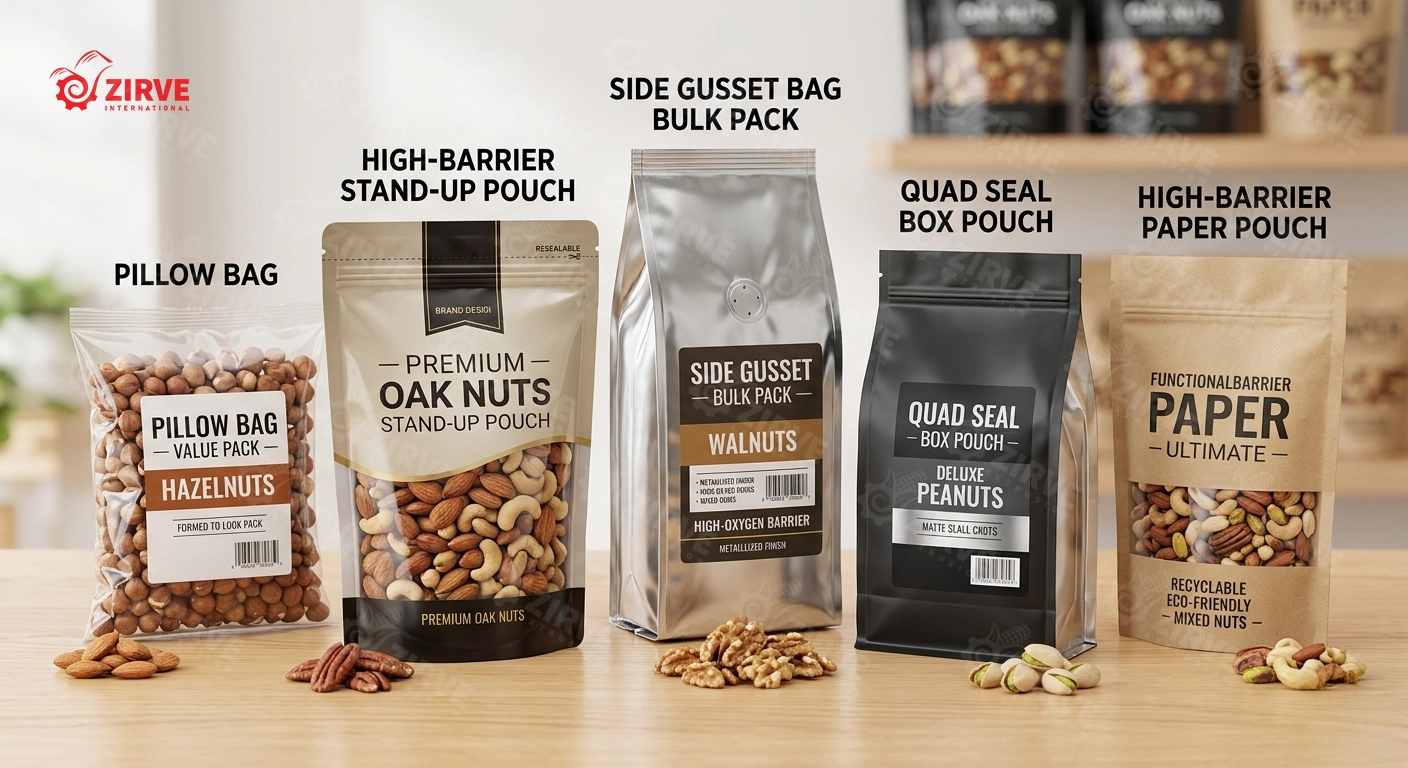
1) Pillow Bag
The pillow bag remains one of the most common formats for lower- to medium-weight flexible packs. Polysack describes the pillow bag as an industry-standard format that is mostly formed on VFFS lines. This makes it attractive for brands that want high speed, relatively simple presentation, and cost-efficient production.
2) Stand-Up Pouch / Doypack
The stand-up pouch is one of the strongest retail formats for nuts because it combines shelf presence, branding space, and convenience. Polysack highlights easy-tear opening, high water-vapor barrier, and recyclable mono-material options in its stand-up pouch range. For nut brands targeting supermarkets, convenience stores, and e-commerce, this format usually gives better visual impact than a standard pillow bag.
3) Quad Seal Bag
The quad seal bag is often used when a brand wants a more premium look and better shelf stability. Polysack describes it as a five-panel structure with four vertical seals that creates a stable, rigid pack shape and gives more printable surface area. In business terms, this is packaging that works harder on the shelf.
4) Flat Bottom / Box Pouch
In many markets, flat-bottom and box-pouch formats are used for premium food products because they stand well, look structured, and communicate higher value. Polysack explicitly notes that quad seal bags are also known as block bottom, flat bottom, or box pouch formats, which reflects how closely these premium bag families overlap in commercial use.
5) Side Gusset Bag
The side gusset bag is practical for larger-volume packs and applications where internal space efficiency matters. Polysack notes that this format is used across food packaging families and is especially established in categories such as coffee and food powders. The same logic can apply to bulk nut packaging where structure and fill efficiency are more important than lightweight presentation.
Features That Improve Nut Packaging Performance
Choosing the right film and the right bag shape is not the whole story. Several package features can materially improve performance:
Resealable zippers help preserve freshness after opening. Stand-up pouches and other premium pack formats frequently use them because the product is often consumed over multiple occasions.
Nitrogen flushing helps reduce residual oxygen inside the pack. The Almond Board specifically identifies nitrogen flushing and vacuum packaging as useful for protecting roasted almonds from oxygen.
Strong barrier layers help reduce spoilage risk and maintain freshness. Coveris describes EVOH barrier films as designed for shelf-life extension and product freshness preservation.
Easy-open features and strong shelf presentation improve consumer convenience and retail performance. Polysack highlights these characteristics for stand-up pouches.
Latest Innovations in Nut Packaging
Recycle-Ready High-Barrier Flexible Packaging
The most important packaging innovation today is not merely “longer shelf life.” It is the attempt to combine shelf-life protection with design-for-recycling compliance. Innovia Films’ 2026 announcements focus on mono-material PP solutions with high-barrier options, while Amcor’s 2026 regulatory outlook emphasizes that European standards are converging around recyclability frameworks tied to PPWR implementation. This is the direction serious packaging development is moving in.
High-Barrier Paper Alternatives
Barrier paper is moving from niche concept to practical packaging platform in selected dry food uses. Mondi’s functional barrier paper portfolio and its ultra-high barrier paper position paper-based structures as designed-for-recycling alternatives with protection against water vapor, grease, and oxygen-sensitive conditions, depending on the grade. For brands selling dry nuts, trail mixes, or premium snack mixes, this is one of the most commercially interesting developments on the market.
Smarter Sorting and Circular Packaging Systems
Smart packaging is not only about consumer interaction. It is also about what happens after disposal. Fost Plus reports that digital watermarking technology, combined with NIR cameras, can improve traceability and sorting of plastic packaging at product level. It also notes pilot work on flexible PP food packaging under HolyGrail 2030. That matters because better sorting is a key part of making recyclable flexible packaging actually work in practice rather than only on paper.
How to Choose the Best Packaging for Nuts
The right packaging depends on your commercial model.
If you are selling premium nuts, roasted nuts, or products for export, a high-barrier format with oxygen control is usually the safest route. That often means a laminated pouch, a metallized structure, or a stronger recyclable barrier solution validated through shelf-life trials. The Almond Board’s guidance on oxygen control and the peanut storage study both support the logic of stronger protection for quality preservation.
If your product is economy positioned and fast moving, a simpler pillow bag may be commercially sufficient, provided the barrier level matches the shelf-life target.
If your brand wants to emphasize sustainability, recyclable mono-material films or high-barrier paper may be worth exploring, but the smart move is to validate them through actual shelf-life testing rather than marketing optimism. Regulations and supplier innovation are both pushing the market in that direction, but product fit still decides success.
Conclusion
The best packaging for nuts sits at the intersection of science, shelf life, and sales. A strong package should protect against oxygen and moisture, support the intended shelf life, match the brand’s retail positioning, and increasingly align with recyclability expectations as markets evolve. High-barrier laminates, EVOH-based films, metallized structures, mono-material recyclable packs, and high-barrier papers all have a place in the nut category, but the right choice depends on the product, the target market, and the business strategy behind it.
The blunt truth is this: in the nut business, bad packaging quietly eats margin. Good packaging protects the product, protects the brand, and protects the sale.
References
- Fu, X., Xing, S., Xiong, H., Min, H., Zhu, X., He, J., Feng, J., & Mu, H. (2018). Effects of packaging materials on storage quality of peanut kernels. PLOS ONE, 13(3), e0190377.
- Almond Board of California. Almond Flavor, Sensory and Shelf-Life Preservation.
- Coveris. EVOH Barrier Films: Extended Shelf Life & Freshness Protection.
- Coveris. Coveris announces major investment in technical films capacity (2024).
- Mondi. Mondi ramps up FunctionalBarrier Paper Ultimate to meet growing demand for sustainable high-barrier paper-based packaging (2025).
- Mondi. FunctionalBarrier papers.
- Mondi. Ultra-high FunctionalBarrier Paper.
- Amcor. Packaging sustainability regulation in Europe 2026.
- Amcor. Packaging and Packaging Waste Regulation: Top 6 Things Brands Need to Know (2026).
- Innovia Films. Innovia presents mono-material PP solutions that meet Design for Recycling requirements at Packaging Innovations 2026.
- Innovia Films. Smarter, Simpler, More Sustainable Packaging—Innovia Unveils What’s Next at Interpack 2026.
- Fost Plus. Digital watermarks used to sort plastic packaging at product level (2025).
- Fost Plus. A European first for Belgium: pilot project sorts flexible food packaging (2025).
- Fost Plus. Activity Report 2024 (published 2025).
- Polysack. Stand Up Pouch Packaging.
- Polysack. Pillow Bag Packaging.
- Polysack. Quad Seal Bag Packaging.
- Polysack. Side Gusset Bag Packaging.
- Polysack. Flow Pack / Flow Wrap Packaging.
Рассылка новостей
Введите свой адрес электронной почты, чтобы получать последние новости от нас


В компании Zirve International мы не просто обычная промышленная компания; мы олицетворяем уникальность и превосходство в области производства и инноваций интегрированных упаковочных систем. Мы гордимся нашей историей, насчитывающей более 30 лет инноваций и развития, которая закрепила наше положение лидеров отрасли благодаря нашей неизменной приверженности предоставлению лучших технологий и решений нашим ценным клиентам.


